
Programme in English
Malmö möts brought together world-leading thinkers, researchers, activists and practitioners for a week of conversations, lectures and workshops on democracy and the future. A significant part of the programme was held in English.
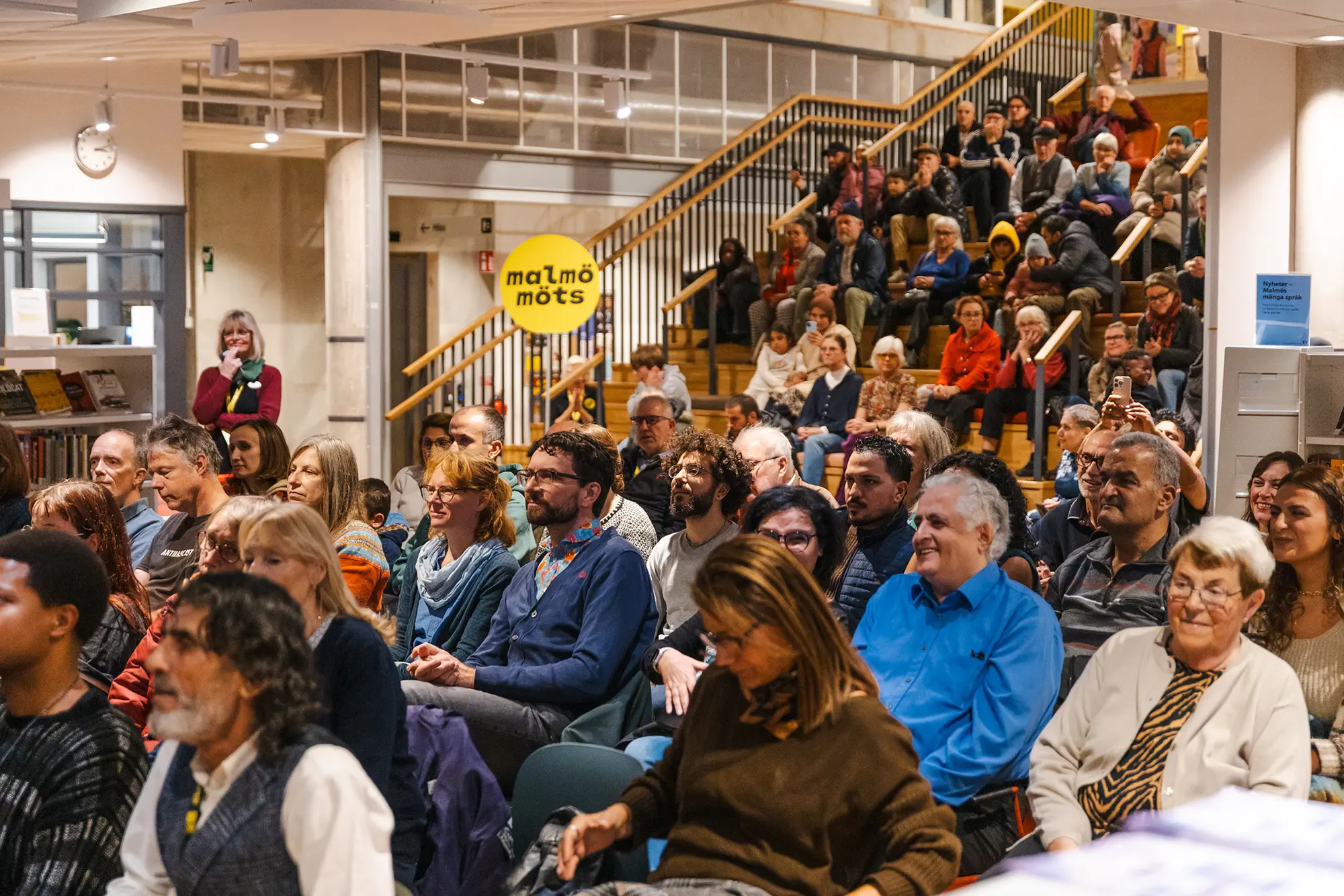
Malmö möts – Democracy Week took place 12–18 June 2026, with a major conference at Malmö Live from 15–17 June and a full day at Malmö University on 16th June. The week gathered international guests alongside local voices to explore some of the most pressing questions of our time: What is democracy, and why is it under threat? What can we do about it – and how do we keep society together in a time of change?
The English-language programme spanned a wide range of themes and formats – from lectures and panel conversations to hands-on workshops and interviews. Pioneering thinkers such as Geoff Mulgan on AI and collective intelligence, Rob Hopkins on radical imagination and the future, and Laura Bates on technology and gender equality all took the stage. The programme explored democratic innovations from across Europe, citizens' assemblies from Belgium to Sweden, and the frontlines of democratic struggle in Georgia and Ukraine.
All events had free entry and were open to everyone. No registration was required unless otherwise stated.
Below you will find a selection of the programme held in English. A selection of the full programme is available here in Swedish.
Hair Is Art – Folkets Park Edition
13th-14th of June 10:00 -17:00 @ Brändan, Folkets Park
Hair Is Art – Folkets Park Edition
A cultural experience celebrating afro hair as art, identity and heritage – with exhibitions, workshops, conversations and a parade in Folkets Park.
Hair Is Art – Folkets Park Edition is a warm, educational and inclusive cultural experience that celebrates afro hair as culture, identity and everyday knowledge. Through exhibitions, workshops and public programming, the event explores how hair carries memories, identity and lived experience – from artistic installations and hair care classes to conversations about culture and representation.
Saturday's programme concludes with GENZ: Braids & Beats at Ridhuset and the Afro Hair Parade – Crowns of Culture, a performative procession through the park where hair stylists, artists and participants showcase braids, natural hair and sculptural hair crowns.
The Upheaval – Panel
13th of June 14:00 – 15:00 @ Malmö Konsthall (Auditorium)
The Upheaval – Panel
A panel conversation with Skånes Dansteater on the role of performing arts in the ecological crisis – exploring ethics, infrastructure and artistic responsibility.
In 2025, choreographer Philippe Blanchard, dramaturg Maika Knoblich and Skånes Dansteater initiated an ongoing inquiry into how the performing arts sector might assume a more active and accountable role in addressing the ecological crisis. Moving beyond emissions data, they reflect critically on the ethics of artistic methodologies, the infrastructures that sustain them and the symbolic economies in which they circulate.
In the panel conversation, they invite the audience to explore what art can communicate and offer in times of crisis that other disciplines perhaps cannot.
Panellists: Philippe Blanchard (FR), Max Liljefors (Lund University) and Lucy Smalley (Malmö Konsthall). Moderated by Maika Knoblich (DE).
The Upheaval – Sharing
13th of June 13:00 – 14:00 @ Konsthallstorget
The Upheaval – Sharing
Site-specific dance performance by Skånes Dansteater on ecological sustainability and relations. Come and go as you please at Konsthallstorget.
Skånes Dansteater, choreographer Philippe Blanchard and dramaturg Maika Knoblich have created The Upheaval – an explorative project on ecologically sustainable methods in the performing arts. Six dancers have developed a site-specific work drawing on philosopher Édouard Glissant's concept of opacity, inviting us to consider a web of relations, histories and gestures rather than fixed origins or meanings.
Come and go as you please at Konsthallstorget.
Dancers: Tomáš Červinka (CZ), Facundo Ebenegger (AR), Samuel Denton (GB/SE), Hazuki Kojima (JP), Michael Marquez (IT/PH), Marion Rastouil (FR) Concept and choreography: Philippe Blanchard (FR) in collaboration with the dancers Dramaturgy: Maika Knoblich (DE) Costume: Christina Neuss (DE)
New avenues for participation: innovating without dividing
15th of June 13:00 – 13:30 @ Malmö Live (Lösningsscenen)
New avenues for participation: innovating without dividing
Panel conversation on digital media, political participation and the new threats to democratic life – arranged by Institut français de Suède. Held in English.
New media plays an increasingly significant role in all aspects of political life – from the broadcasting of political information to campaigning and opinion-forming. Digital tools offer new avenues for civic expression and political engagement, but also open the door to new threats.
This conversation explores how the digital sphere has become a central part of our societies, and what the consequences are for both individuals and the political community.
Panellists: Nils Gustafsson, senior lecturer at Lund University, affiliated with the Centre for Preparedness and Resilience (LUPREP); Anne-Françoise Hivert, journalist based in Lund covering the Nordic countries for Le Monde; Maxime Audinet (Inalco, via video link). Moderated by Alberto Fernández Gibaja (International IDEA).
Arranged by Institut français de Suède – a French institution promoting dialogue and exchange between France and Sweden in the cultural, linguistic, academic and scientific fields.
Finn Williams interviews Geoff Mulgan (UK)
15th of June 14:15 – 14:35 @ Malmö Live (Intervjuscenen)
Finn Williams interviews Geoff Mulgan (UK)
A conversation on radical social imagination and collective intelligence as tools for addressing global challenges – with one of the world's leading thinkers on social innovation. Held in English.
How can innovation and creativity generate new solutions to complex problems like climate change and democratic decline? And how do we mobilise collective intelligence to shape the future?
Professor Geoff Mulgan (University College London) is one of the world's leading thinkers on social innovation and democratic development. He has moved between academia, the British government and non-profit organisations, written numerous books and worked at the BBC. In this interview, we explore his work on radical social imagination and collective thinking as tools for navigating global challenges.
Mulgan is interviewed by Finn Williams, City Architect of Malmö.
Social movements and crises – historical drivers of renewal
15th of June 14:45 – 15:15 @ Malmö Live (Kuben)
Social movements and crises – historical drivers of renewal
A lecture on how social movements and crises have historically shaped democratic renewal – arranged by Institut français de Suède. Held in English.
Social movements have historically paved the way for ruptures and democratic renewal. But what can we learn from comparing different eras and contexts?
With expertise in feminist and youth movements in the Nordic countries and social movements in 19th century France, Elisabeth Elgán (Stockholm University) and Nicolas Delalande (Sciences Po Paris) will discuss similarities and differences across epochs, questioning how social movements and crises shape political life. Additional video contributions will be given by Louis Chauvel (University of Luxembourg) and Katrine Fangen (University of Oslo). Moderated by Alexander Hudson (International IDEA).
Arranged by Institut français de Suède – a French institution promoting dialogue and exchange between France and Sweden in the cultural, linguistic, academic and scientific fields.
The 10 Best European Democratic Innovations
15th of June 15:15 – 15:45 @ Malmö Live (Lösningsscenen)
The 10 Best European Democratic Innovations
A lecture on ten inspiring examples of democratic innovation from cities across Europe – with Adela King from European Capital of Democracy.
Cities across Europe are developing new ways to involve citizens in decisions that shape their everyday lives and futures. This lecture presents ten concrete examples of democratic innovation from the European city network ECoD.
From monthly breakfasts in Cascais where taboo subjects such as racism and mental health are openly discussed, to the Children's Council in Valongo where 24 children aged 7 to 9 meet every two weeks to advise the mayor. In Rotterdam, democracy takes shape on wheels through a mobile service point giving residents with mobility challenges or language barriers access to municipal services. In Gdańsk, a green civic budget gives residents direct decision-making power over the city's green spaces, and in Ankara a citizen centre has organised nearly 4,000 public events over five years to make participation a living cultural practice.
Be inspired by how other cities work with democracy – and consider what Malmö might learn from them.
Presenter: Adela King, City Applications & Network Manager, European Capital of Democracy.
Interview with Pier Luigi Sacco on Culture 3.0
15th of June 15:45 – 16:05 @ Malmö Live (Intervjuscenen)
Interview with Pier Luigi Sacco on Culture 3.0
A conversation with Pier Luigi Sacco on how culture drives economic growth, creativity and social cohesion – a preview of his full lecture on 17 June. Held in English.
How can investing in culture create new opportunities for growth, creativity and social cohesion? And how can the cultural sector serve as a catalyst for sustainable development and a more inclusive economy?
Pier Luigi Sacco is Professor of Bio-behavioural Economics at the University of Chieti-Pescara, Harvard metaLAB and the Policy Evidence Centre at Newcastle University. In this conversation, he introduces the concept of Culture 3.0 – showing how culture is not only an aesthetic and social force, but also a foundation for economic growth and innovation. Essential listening for cultural practitioners, policymakers and economists seeking to understand how culture can be integrated into societal planning.
This interview is a preview of Sacco's full lecture in Kuben on Wednesday 17 June.
Resilient, Vibrant and Prepared Cities in the Nordic Region
16th of June 09:15 – 09:45 @ Malmö Live (Kongressen)
Resilient, Vibrant and Prepared Cities in the Nordic Region
Lecture with Jeppe Albers, founder and CEO of Nordic Safe Cities, on how Nordic cities can build resilience against polarisation, digital manipulation and insecurity.
Meeting the future requires a new form of robustness and preparedness – grounded in democratic values, solidarity and strong local communities.
Through Nordic Safe Cities, actors from across the Nordic region come together to show how cities can become centres of resilient democracies. The focus is on concrete solutions and collaborations that strengthen trust, prevent segregation and promote safety, community, culture and digital resilience – so that free, open and inclusive societies can continue to flourish even in times of uncertainty.
Jeppe Albers shows how we can discuss security from a geopolitical perspective and how local solutions can contribute to a more stable and democratic region. Nordic Safe Cities works to generate knowledge, drive initiatives and build partnerships between cities, national authorities, civil society, foundations and private companies across the Nordic region.
Geoff Mulgan on AI and Collective Intelligence (UK)
16th of June 09:45 – 10:30 @ Malmö Live (Kongressen)
Geoff Mulgan on AI and Collective Intelligence (UK)
Lecture by pioneering thinker Geoff Mulgan on how artificial intelligence and collective thinking can address global challenges – and shape a sustainable, democratic future.
Democracy is not just a system of government – it is a system that can amplify society's collective knowledge and experience. But it can just as easily turn up the volume on prejudice, disinformation and collective mistakes.
Professor Geoff Mulgan (University College London) is one of the world's leading thinkers on social innovation and democratic development. He has moved between academia, the British government and non-profit organisations, written numerous books and worked at the BBC.
"I will talk about the many ways in which democracy needs to be reformed and reinvented – to rebuild trust and to maximise society's collective intelligence, including both the positive and negative effects of AI," says Geoff Mulgan.
AI can be both a threat to democracy and a tool for it. Don't miss the chance to hear Mulgan speak about how we can shape a future where technology strengthens our ability to make wise decisions together.
Georgian Youth at Europe's Frontline: Fight for Democracy
16th of June 10:30 – 11:30 @ Niagara, Malmö University (Sal B0E07)
Georgian Youth at Europe's Frontline: Fight for Democracy
Lecture and discussion with two Georgian civil society leaders on resisting authoritarianism and defending democracy under threat.
Once a beacon of reform and democratic development in the region, Georgia is now sliding toward a Russian-style autocracy. Two young leaders of Georgian civil society explore how the nation became one of Europe's fastest-declining democracies.
George Melashvili and Shako Chkheidze are the founders of the Europe-Georgia Institute (EGI), a leading Georgian civil society organisation established in 2015. EGI has developed an extensive portfolio of campaigns and educational programmes – but following the enactment of repressive, Russian-style laws targeting civil society, the organisation's influential work has made it a primary target of the current regime.
We will hear how the ruling party leveraged the war in Ukraine to attack civil society, and how the struggle to defend democracy became a daily reality for Georgians after 2024. The speakers will share their first-hand experiences on the front lines of this democratic struggle.
George and Shako's connection to Malmö began through the Swedish Institute Academy for Young Professionals at Malmö University, leading to a partnership that has fuelled several significant initiatives in Georgia – including the translation of the Swedish educational floor game "Electionville" and the integration of social auditing into the high school civic education curriculum.
Organised by Malmö University's network for Peace, Democracy, and Human Rights within Campus Total Defense.
Cognitive Austerity and Culture 3.0 (IT)
16th of June 11:00 – 11:45 @ Malmö Live (Kuben)
Cognitive Austerity and Culture 3.0 (IT)
Lecture by Professor Pier Luigi Sacco on algorithmic media, activation costs and the democratic consequences of shrinking experiential spaces. Held in English.
Why do citizens in information-rich democracies show declining engagement with complex culture, politics and deliberation? Professor Pier Luigi Sacco argues that the answer lies not in preferences or motivation, but in the dynamics of our cognitive infrastructure.
Drawing on an information-theoretical framework, he formalises the "activation costs" of meaningful engagement, showing how algorithmic media systematically shrinks citizens' experiential spaces by flooding digital environments with optimised low-cost alternatives. Once the capacity for complex engagement is lost, it is harder to rebuild than it was to maintain.
But by reinvesting in culture, societies can create new opportunities for growth, creativity and social cohesion.
Pier Luigi Sacco is Professor of Bio-behavioural Economics at the University of Chieti-Pescara, Harvard metaLAB and the Policy Evidence Centre at Newcastle University.
Academic Freedom as Early-Warning Sign of Democratic Erosion
16th of June 11:45 – 12:45 @ Niagara, Malmö University (Sal B0E07)
Academic Freedom as Early-Warning Sign of Democratic Erosion
Democratic erosion often begins with targeting of university subjects disliked by authorities, e.g. diversity, equity, integration, or democracy. The talk discusses examples from around the globe.
Bo Petersson is since 2010 Professor of Political Science and IMER at the Department of Global Political Studies (GPS). He is the director of the research platform RUCARR - Russia, Ukraine and the Caucasus Regional Research at the Faculty of Culture and Society (during the period 2016-2024 together with Professor Karina Vamling). Among ongoing external assignments, Petersson is a member of the board of the Swedish Network for European Research in Political Science (SNES).
Thiem Hai Bui is a researcher at the Department of Global Political Studies, Malmö University. Prior to this position, he was a researcher at the Stockholm Center for Global Asia, Stockholm University. His previous positions include senior lecturer in political economy at Vietnam National University-Hanoi, senior lecturer at the Diplomatic Academy of Vietnam, senior research fellow at the Institute for Legislative Studies under the Vietnamese National Assembly.
Academic freedom as early-warning sign of democratic erosion
On Imagination, Participation and Democracy (UK)
16th of June 12:00 – 12:20 @ Malmö Live (Intervjuscenen)
On Imagination, Participation and Democracy (UK)
Rob Hopkins in conversation on storytelling, positive future scenarios and the power of hope to inspire social change in times of climate crisis. Held in English.
What happens to a society when imagination and creativity disappear? How do the stories we consume shape the realities we create? And where do we find the inspiration and energy to stay engaged?
These are the questions Rob Hopkins and Duncan Geere dive into – as a warm-up ahead of Rob's lecture and workshop.
Rob Hopkins is co-founder of Transition Network and Transition Town Totnes – a progressive thinker and doer who speaks about hope and the possibility of building something different, without looking away from the difficult realities of today.
Duncan Geere is an information designer, musician and climate activist with a deep familiarity with Rob Hopkins' work, making for a rich and wide-ranging conversation.
Laura Bates (UK) on Building Technology That Works for Everyone
16th of June 12:30 – 13:15 @ Malmö Live (Kongressen)
Laura Bates (UK) on Building Technology That Works for Everyone
Lecture by activist and author Laura Bates on the fight for women's rights and the urgent need to develop new technology that does not reinforce inequality.
The fight for women's rights is ongoing – and under new attack. Laura Bates is the founder of the Everyday Sexism Project, a growing collection of over 200,000 testimonies about gender inequality. The project raises awareness of sexism and provides a space where survivors can be heard and believed, with stories used to drive real change in collaboration with organisations such as the UN and the Council of Europe.
Facebook changing its policies on sexual violence, consent being introduced into the British national curriculum, and the UK's transport authority transforming its approach to sexual harassment are all partly the result of Laura Bates' and other activists' work.
In 2025, she published The New Age of Sexism: How AI and Emerging Technologies Are Reinventing Misogyny, examining how our lives are being infiltrated by readily available technologies. She finds a wild west where existing forms of discrimination, inequality and harassment are being coded into a future we will all live, work and love in – unless we seize the opportunity to demand and create change.
The New Way of Democracy: Citizens' Assemblies (BE/NL/SE)
16th of June 12:45 – 13:15 @ Malmö Live (Lösningsscenen)
The New Way of Democracy: Citizens' Assemblies (BE/NL/SE)
Representatives from five cities and regions in northern Europe share their experiences of citizens' assemblies – a growing form of democratic participation. Held in English.
Citizens' assemblies have become a growing trend at both local and national level, tackling complex issues such as climate change and social justice. In this session, representatives from five cities and regions that have recently hosted citizens' assemblies share their different perspectives and experiences.
The discussion is led by Christiaan Teule, strategic policy advisor for participation in the province of Drenthe in the Netherlands, who is currently preparing for a second citizens' assembly. He is joined by colleague Anne de Zeeuw and representatives from Groningen (NL), Mechelen (BE), Roeselare (BE) and Malmö (SE).
A workshop offering the opportunity to deepen the dialogue takes place at 13:30–14:30 in the Greenroom.
Organised in collaboration with the Environmental Administration in the City of Malmö and the network Speak Up.
Rob Hopkins: How to Fall in Love with the Future (UK)
16th of June 13:00 – 13:45 @ Malmö Live (Kuben)
Rob Hopkins: How to Fall in Love with the Future (UK)
Lecture by Rob Hopkins, founder of the Transition Movement, on the power of imagination to build sustainable and hopeful societies. Held in English.
How we imagine tomorrow determines what we dare to build today. In a time when dystopian narratives often dominate public discourse, we face a critical question: what role does our imagination play in creating sustainable societies?
As founder of the Transition Movement and author of the recently published How to Fall in Love with the Future, Rob Hopkins is a leading voice in shifting focus from what can go wrong to what is possible to achieve. An Ashoka Fellow, TED Global speaker and creator of the podcast From What If to What Next, Rob has dedicated his life to showing how we can think beyond crisis. He holds a PhD from the University of Plymouth and two honorary doctorates.
Rob Hopkins is a progressive thinker and doer who speaks about hope and the possibility of building something different – without looking away from the difficult realities of today.
Loveable and Monstrous Democracy in Cultural Institutions
16th of June 13:00 – 14:40 @ Niagara, Malmö University (Sal A0311)
Loveable and Monstrous Democracy in Cultural Institutions
Workshop combining two creative methods to explore how archives, museums and libraries uphold democracy in their everyday work. Limited to 30 participants.
How do cultural institutions like archives, libraries and museums fulfil their democratic role in practice – and what are the challenges they face?
This workshop targets professionals working in cultural institutions and supports their understanding of how democracy plays out in their everyday work. Participants will write a love letter articulating why democracy is worth the effort, and explore the more monstrous aspects of democratic work through the "Flower Monster" and paper dolls for democracy – tools developed within the CEMES collaboration together with researchers from Lund and Copenhagen University.
The workshop opens up space for critical and emotional reflections on the role of cultural institutions in upholding democracy in society.
Places are limited to 30 participants.
Are Citizens' Assemblies the Revitalisation of Democracy?
16th of June 13:45 – 14:45 @ Malmö Live (Greenroom)
Are Citizens' Assemblies the Revitalisation of Democracy?
Interactive international panel and workshop on the strengths and weaknesses of citizens' assemblies – with representatives from Belgium, the Netherlands and Sweden.
Citizens' assemblies have in recent years become a growing trend at both local and national level, seen as a way to revitalise traditional local democracy and enable a different kind of democratic discussion on complex issues.
In this panel discussion and workshop, we will explore together the best ways to organise a meaningful citizens' assembly. What are the dos and don'ts? The advantages and disadvantages? How can we make these assemblies work better to strengthen democracy – and are they the best way for citizens to make their voices heard?
Meet representatives from Belgium (Mechelen and Roeselare), the Netherlands (Region Drenthe and the city of Groningen) and Sweden (Malmö) in a conversation moderated by the University of Groningen.
This workshop is linked to the Environmental Administration and the project Speak Up.
Deepfake Democracy Group: Defending Trust in the Age of AI
16th of June 15:00 – 16:00 @ Niagara, Malmö University (Sal A0307)
Deepfake Democracy Group: Defending Trust in the Age of AI
Panel on how deepfakes affect elections with Malmö University researchers and students sharing tools for detection, digital literacy, and democratic resilience.
This event introduces the Deepfake Democracy Group, an interdisciplinary team of computer sciences, international relations, global political studies, media studies, communications, interaction designers and criminologist at Malmö University that studies how AI-generated synthetic media may inform European and Nordic democracies. Participants will hear inputs on the rapid growth of political deepfakes, why humans detect them only slightly better than chance, and how such content can damage reputations, voting intentions, and trust in news.
The session combines short talks from the research tracks, a moderated panel, and hands-on examples where visitors compare real and synthetic video and discuss how design, policy, and education can strengthen democratic resilience. Students from the Vertically Integrated Project (VIP) “Deepfake Democracy Group” present case studies from Sweden and recent European elections and demonstrate EU policies and prototype detection. The aim is to give attendees a clearer understanding of deepfake threats and an accessible toolkit of questions, practices, and resources they can use in everyday democratic life in Malmö and across the Öresund region.
A Time Travel Masterclass for Novice Adventurers (UK)
16th of June 15:00 – 16:30 @ Malmö Live (Greenroom)
A Time Travel Masterclass for Novice Adventurers (UK)
Workshop with Rob Hopkins on imagining radically different futures – and what it takes to build more sustainable and democratic societies. Held in English.
What does it feel like to travel to a future where we have managed to halt climate change, mass extinction and war? And what needs to happen in our present reality to make that future possible? What kinds of stories and images do we need in order to create hope and agency for brighter futures?
Without the ability to imagine more sustainable and just societies, we cannot build them. This workshop explores how imagination and the capacity to envision play a crucial role in creating more sustainable and democratic societies.
Rob Hopkins is the founder of the Transition Movement and author of the recently published How to Fall in Love with the Future – a progressive thinker and doer who speaks about hope and the possibility of building something different, without looking away from the difficult realities of today.
Co-creating the City with Wildlife on Your Mind
16th of June 15:30 – 15:50 @ Malmö Live (Intervjuscenen)
Co-creating the City with Wildlife on Your Mind
Interview with Mark Van der Veken on inclusive co-creation methods in urban planning – what if flora and fauna had a say in shaping our cities? Held in English.
What would bats, fish and water lilies choose if they had the chance to be consulted? You might be surprised. In the Belgian city of Mechelen, nature was given a role in the participatory process for place-making in and around the river running through the city centre.
In a unique experiment with "wild" participatory exercises, citizens reconnected spatially and emotionally with nature and with the cooling blue-green axis running through the city – leading to a new and holistic approach to urban planning: let's co-create a river!
Mark Van der Veken's mission is to expand the bandwidth for genuine engagement and connection, reach underexposed audiences in an accessible and mobilising way, and influence existing policy by involving unheard voices.
Organised in collaboration with the Environmental Administration and the network Speak Up.
The Courage to Exist: Queer Migration and the Future of Democracy
16th of June 15:30 – 16:00 @ Malmö Live (Livelokalerna)
The Courage to Exist: Queer Migration and the Future of Democracy
A conversation arranged by RFSL Malmö on queer migration as a democratic issue – focusing on courage, resistance and concrete ways forward. Held in English.
How does Sweden's reputation as an LGBTQI+-friendly country square with current asylum practices? In this 30-minute conversation, we explore queer migration as a critical democratic issue. We examine the heavy burden of proof placed on asylum seekers, while above all highlighting the courage shown by queer migrants and civil society in Malmö.
We conclude with concrete ways forward: from municipal partnerships and sustainable support systems to the importance of safe spaces, such as the new queer house at Mitt Möllan.
Panellists: Representatives from RFSL Malmö with expertise in queer migration and asylum law.
FUTURES Thoughts with Geoff Mulgan
16th of June 18:00 – 19:00 @ Niagara, Malmö University (Niagara café, floor 2)
FUTURES Thoughts with Geoff Mulgan
A conversation on art, radical imagination and hope, this talk with Geoff Mulgan is part of the FUTURES Thoughts talk series at Malmö Research Centre for Imagining and Co-creating Futures (ICF).
Geoff Mulgan is professor of Collective Intelligence, Public Policy and Social Innovation at University College London, UK and keynote address at Malmö Möts. The talk will be curated by Marika Hedemyr and focus on his work pertaining to art, radical imagination and hope as capacities for reimagining democracy.
In this talk, Mulgan will address the role of the arts in social imagination and shaping the future. How much is their role to warn, to testify, to spot emergent patterns or to make the present feel unnatural? And how well placed are they now to do more detailed design, future visions and pathways? He'll look at the role of radical imagination, utopias and distopias, and why more prescriptive literature, film or art sometimes feels banal. He will argue that the idea of the arts as trailblazers or legislators is sometimes misunderstood. They contribute best at a tangent rather than head on, encouraging hope by showing the plasticity of the world, and contributing to explorations of possible futures and pathways more than precise blueprints.
The economy in a warming world
17th of June 11:00 – 11:45 @ Malmö Live (Kongressen)
The economy in a warming world
A conversation on jobs, welfare and competitiveness in a world of accelerating climate crisis – with economist Annika Winsth, ecological economist Jennifer Hinton and moderator Caroline Nordvall.
How does Swedish society hold up in a global context when crises follow one after another and the planet's thermostat is broken? In this conversation, Annika Winsth and Jennifer Hinton untangle how we get jobs, welfare and competitiveness in order – and what happens when emissions must be reduced rapidly.
What role do politics, business and financial markets play in the transition? And how do we create an economy that works – even in a warmer world?
Annika Winsth is the analyst who became Chief Economist at Nordea, board member of the School of Economics at Lund University and honorary doctor there since 2018. Jennifer Hinton is an ecological economist and systems researcher who has been active in sustainable economics for over 15 years, focusing on how societies relate to profit and how this affects global sustainability challenges such as climate change and inequality.
The conversation is moderated by Caroline Nordvall, Secretary General of the Swedish Sustainable Business Network.
Post-growth Economics
17th of June 13:30 – 13:50 @ Malmö Live (Intervjuscenen)
Post-growth economics
Jennifer Hinton in conversation on post-growth economics and how the way we organise our economy shapes society – interviewed by Elin Fjellman, Sydsvenskan. Held in English.
How we organise our economy and our society are deeply intertwined. Jennifer Hinton is an ecological economist and systems researcher who has been active in sustainable economics for over 15 years, focusing on how societies relate to profit and how this relationship affects global sustainability challenges such as climate change and inequality.
With a gift for explaining complex challenges in accessible ways, Hinton offers a path forward that leaves you with motivation and hope – no small feat in a time defined by the urgency of the climate crisis.
Jennifer Hinton is interviewed by Elin Fjellman, journalist at Sydsvenskan.
How do we prepare for the peace of the future?
17th of June 13:30 – 14:15 @ Malmö Live (Kongressen)
How do we prepare for the peace of the future?
Panel on security, diplomacy and democratic resilience – with perspectives from Ukraine, international disarmament and Swedish defence. Held in English.
What does it mean to prepare for peace when the law of the strongest increasingly overrides international agreements? And how do we balance a stronger defence with the protection of our democratic values?
Democratic societies are being tested and autocracy is gaining ground. In this panel, you will hear perspectives from Ukraine, from international disarmament work and from Swedish defence. The session opens with an address by Alina Zubkovych, followed by a panel conversation.
Alina Zubkovych is chair of the Nordic Ukraine Forum in Sweden and Academic Director at the Kyiv School of Economics. She combines academic expertise with high-level government relations and is one of the leading voices building bridges between Nordic and Ukrainian security policy.
Beatrice Fihn is senior fellow at the UN Institute for Disarmament Research (UNIDIR) and founder of Lex International Fund. Between 2017 and 2023 she was Secretary General of the International Campaign to Abolish Nuclear Weapons (ICAN) – the organisation awarded the Nobel Peace Prize that same year.
Moderated by Katarina Tracz, security policy analyst and advisor at the intersection of communication and security policy, member of the Expert Group for Aid Studies and board member of the Sweden–Lithuania Cooperation Fund.
Designing the Futures: A Workshop for Democratic Cities
17th of June 13:30 – 14:30 @ Malmö Live (Livelokalerna)
Designing the Futures: A Workshop for Democratic Cities
Hands-on workshop where you collaborate to visualise possible futures for the public sector in 2050. No prior experience needed – just curiosity and a willingness to time travel! Held in English.
Step into the year 2050! In this playful, hands-on workshop, you collaborate with other participants to visualise and co-create possible futures for the public sector – exploring how design and foresight can help build more democratic and inclusive cities.
Through two accessible methods, you will learn how to bring creativity and playfulness to work on important societal issues. You will leave the workshop with concrete tools to use in your own organisation. No prior experience needed – just curiosity and a willingness to time travel!
The workshop is led by Eze Montenegro, Strategic Change Leader at the Cultural Administration, City of Malmö (AR/SE).
10 Tips for Young People Who Want to Secure the Future
17th of June 14:00 – 14:45 @ Malmö Live (Demokrati Live)
10 Tips for Young People Who Want to Secure the Future
A conversation with Nordic Pioneers on how young people can find their way into civic engagement – and why youth role models are crucial for building inclusive and democratic societies.
More and more young people want to shape the world around them, but many don't know how or where to start. At the same time, society struggles to reach those young people who feel furthest from influence.
In this conversation, Ronas Korkmaz, leader of Nordic Pioneers, and pioneer Nazwa Börman share perspectives on how pathways into engagement can be created – and why young role models play a decisive role in strengthening participation, belonging and resilience across the Nordic region. The conversation explores what drives youth engagement, what barriers exist and what role young people play in shaping more inclusive and democratic societies.
Nordic Pioneers is a youth-driven programme and community under the Nordic organisation Nordic Safe Cities. Since 2020, they have gathered and supported hundreds of Nordic young people engaged in open, inclusive and safe local communities – from social entrepreneurs and cultural creators to human rights activists and democracy defenders. Nordic Pioneer Lab is an annual talent programme where 80–100 engaged young people from across the Nordic region come together to gain tools, networks and support to drive change.
What Can Theatre and Democracy Teach Each Other?
17th of June 17:15 – 17:45 @ Malmö Live (Lösningsscenen)
What Can Theatre and Democracy Teach Each Other?
Four Skåne-based researchers and practitioners in performing arts explore what theatre and democracy can learn from each other.
What can theatre teach democracy – and what can democracy teach theatre? This panel draws on artistic research and fieldwork in grassroots democratic movements to explore how we can shift from hierarchical to collective ways of working in contemporary theatre – and what this might offer a broader democratic practice.
Dramaturgies of Democracy is a transnational artistic research project funded by the Swedish Research Council, bringing together researchers and practitioners from Sweden, Denmark, the UK, Belgium and the Balkans.
Panellists: Jörgen Dahlqvist (Malmö Theatre Academy, Lund University), playwright, director and researcher Emma Bexell (Lund University), artist and researcher Rikard Loman (Lund University), researcher in dramaturgy, cultural policy and the public sphere Duška Radosavljević (Lund University), dramaturg, researcher and project leader.
Kontaktinformation
Malmö möts
- E-post:
- malmomots@malmo.se
- Postadress:
- Malmö stad Malmö möts 205 80 Malmö
Sidan senast uppdaterad: